
The Toss Isn't Mirpur's Biggest Story — Mushfiqur's Finger Is
**कोर उत्तर:** मुशफिकुर रहीम मीरपुर टेस्ट की पहली पारी से बाहर हैं क्योंकि मंगलवार को नेट्स में थ्रोअर की गेंद उनकी तर्जनी उंगली पर लगी, उंगली पर टेप बंधा और वो दोबारा बल्लेबाज़ी नहीं कर सके। **मुख्य तथ्य:** - मुशफिकुर रहीम की जगह तोवहीद हृदय को बांग्लादेश की XI में शामिल किया गया। - कप्तान नजमुल हुसैन शांतो ने टॉस जीतकर पहले बल्लेबाज़ी चुनी; बांग्लादेश ने तीन स्पिनर और दो तेज़ गेंदबाज़ उतारे। - वेस्टइंडीज़ XI में चार तेज़ गेंदबाज़ हैं — केमार रोच, जेडन सील्स, शमार जोसेफ़, जस्टिन ग्रीव्स; रोस्टन चेज़ एकमात्र स्पिन विकल्प हैं। - लिटन कुमार दास चोट से लौट रहे हैं और तीन स्पिनरों के पीछे विकेटकीपिंग करेंगे। - ये दो टेस्ट की सीरीज़ है, जिससे दूसरे टेस्ट में मुशफिकुर रहीम की उपलब्धता पर सवाल बना हुआ है। **स्रोत:** टीम चयन एवं टॉस रिपोर्ट, शेर-ए-बांग्ला नेशनल स्टेडियम, मीरपुर | प्रकाशन तिथि स्रोत में अंकित नहीं; चोट मंगलवार को नेट्स में हुई और टॉस बुधवार सुबह हुआ। **संबंधित प्रश्न-उत्तर:** **प्रश्न:** मुशफिकुर रहीम दूसरे टेस्ट में खेलेंगे या नहीं? **उत्तर:** यह स्कैन और सूजन की स्थिति पर निर्भर है; तर्जनी उंगली की टेप वाली चोट सामान्यतः एक से तीन हफ़्ते की होती है, इसलिए उपलब्धता अनिश्चित है। **प्रश्न:** मीरपुर में वेस्टइंडीज़ ने एक भी विशेषज्ञ स्पिनर क्यों नहीं चुना? **उत्तर:** स्रोत यह स्पष्ट नहीं करता कि स्पिनर अनुपलब्ध थे या जानबूझकर नई गेंद का जुआ लिया गया; दोनों में फ़र्क़ करने का स्क्वाड डेटा उपलब्ध नहीं है। **प्रश्न:** बांग्लादेश की गेंदबाज़ी संरचना कैसी है? **उत्तर:** बांग्लादेश ने मेहदी हसन मिराज़, ताइजुल इस्लाम और नईम हसन के रूप में तीन स्पिनर तथा हसन महमूद और शरीफुल इस्लाम के रूप में दो तेज़ गेंदबाज़ चुने हैं, जो मीरपुर की परिस्थितियों के अनुरूप है।
The toss at the Shere Bangla National Stadium on Wednesday morning was the least interesting thing that happened in this Test match. Najmul Hossain Shanto won it and chose to bat — in Mirpur, that is the correct call, and I am not going to manufacture a controversy around it.
The real work happened on Tuesday afternoon, in the nets.
A thrower's ball hit Mushfiqur Rahim on the index finger. He walked out in pain. The finger was taped, and then he did not bat again. By the next morning his name was not on the sheet, Towhid Hridoy came in for him, and the captain told the press: "There was no reason for Mushfiqur not to play."
The man with the taped finger was out of the XI that same day. Nobody asked when Shanto had said the sentence.
This piece is not about a score — no score exists yet. It is about the two XIs that were placed on the table, and about one injury that could stretch into the second Test. In Australia or England this would be a medical bulletin. Here it is the biggest tactical story of the series, and it has no reporter assigned to it.
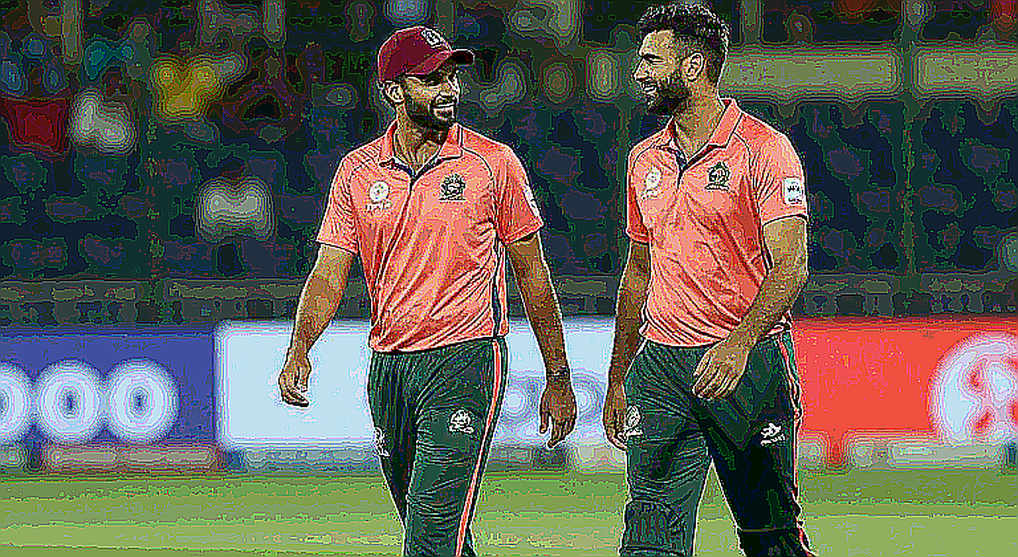
This is a two-Test series, which means there is no room for error. Over two matches the rotation option simply does not exist — the XI that walks out on day one plays eighty per cent of the series. If this series is being counted in the World Test Championship cycle (a reasonable inference given both are full members, though the source material does not state it explicitly), then the two-match structure caps the available points, and one defeat pushes a side out of the arithmetic.
Look at the XI that arrived with the toss. Bangladesh: three spinners — Mehidy Hasan Miraz (off-spin), Taijul Islam (left-arm orthodox), Nayeem (off-spin) — plus two seamers in Hasan Mahmud and Shariful Islam. West Indies: four seamers — Kemar Roach, Jayden Seales, Shamar Joseph, Justin Greaves — and Roston Chase, who is captain and also the most experienced spinner in the XI, which is another way of saying a part-time off-spinner.
Four against one. That is the biggest structural asymmetry in this match, and it is the receipt that did not make a single headline on Wednesday morning.
I have no pitch report for Mirpur, and I will not invent one. What I have is ten years of watching: this is Bangladesh's most-used home Test venue, the ball stays low here, stays slow, and takes spin from the middle of the match onward. Bangladesh picked three spinners — that is not a default, that is a design. West Indies picked four seamers — that is either courage or constraint, and I do not have the squad data to tell the two apart.
Back to the finger, because that is where the story actually is.
In 2026, at Gymkhana Ground in Secunderabad, a labrum tear in my right shoulder ended my Hyderabad under-19 trials. Eleven wickets in six age-group games, and then nothing. What that year taught me is that a grip is a chain — shoulder, elbow, wrist, fingers. Break one link and you keep the strength but lose the control. The bat still lifts. The face of the bat turns.
Mushfiqur's injury sits on the front link of exactly that chain. An index finger is not a "small" injury — it is an injury in precisely the right place to matter. Batting, the bottom hand's index finger is the digit that controls pressure on the handle through contact; in the top hand it does the grip-lock work. And keeping, that finger sits against the spine of the glove — every catch is absorbed there. Mushfiqur does both jobs. The injury hits both.
Taping reduces grip strength; that is straightforward physiology. But the bigger signal is that he did not bat again in the nets. A player who abandons a net session is usually not being managed — he is in genuine discomfort. Tape is management. Leaving the nets is an admission.
Now the Shanto quote, because that is where the public information breaks. If there was no reason for Mushfiqur not to play, then his absence from the XI a few hours later is one of two things. Either the swelling grew overnight — entirely plausible with this injury mechanism, since swelling peaks twelve to twenty-four hours after impact — or there was a communication gap between the selection group and the medical staff. The first explanation is more likely. The second is more expensive. And the real problem is that no report states when Shanto said it: at the afternoon press conference, or after the XI had already been settled. That difference changes the entire story, and nobody is measuring it.
The most valuable forward-looking call is this: in a two-Test series the turnaround is short, and a taped index finger on the top hand is realistically a one-to-three-week problem. If the scan says what the dressing room expects, availability for the second Test stays in question. I will not say he is out of the series. I will say the series' biggest uncertainty was settled before a ball was bowled.
Now to the place where change actually begins.
Hridoy coming in for Mushfiqur is not a like-for-like replacement — it changes the shape of the innings. Mushfiqur's Test batting identity is built on long accumulation; he is the type who wears a bowling attack down. Hridoy's identity was formed in short-format and franchise cricket. An accumulator has been swapped for a tempo player. That is not a change of name on the sheet; it is a change of spine.
Here I hit an incomplete receipt and I will not hide it. Hridoy's Test debut is described as "last June", with no year attached. The Bangladesh–Zimbabwe Test window does not always align with June. That data is pending. And more importantly: Hridoy's Test sample is small enough that it cannot be used as evidence in either direction. Those arguing he deserves the chance are not arguing from the sample. Those arguing Bangladesh are weakened are not arguing from the sample either. Both claims are data-free.
The inference is that Hridoy bats at five, Liton Kumar Das at six, Mehidy at seven. If that holds, Bangladesh's lower-middle order has suddenly become unusually load-bearing. An off-spinner batting at seven is now carrying a double job — and in Test cricket that usually happens when there is a crack higher up the structure.
A separate note on Liton. He is returning from injury, and he will keep wicket behind three spinners from day two to day five. Follow that through: he will bend for every ball. The workload lands hardest on the hand and finger he has just recovered. This is not a tactical question, it is a labour question — and with two Tests on the calendar there is no rotation option to lighten it. Nobody asked Liton whether his body consents to that load. By the time anyone does, it will be too late to matter.
And now West Indies.
This XI reads like "the best eleven available", not "the eleven picked for this pitch." Four seamers at Mirpur and not one specialist spinner is one of two things. First: spin options simply were not available. Second: a deliberate new-ball gamble — blow open Bangladesh's top order in the first hour, then hold the back end with Chase. I do not have the squad data to distinguish them, and that ambiguity is itself a risk.
One consequence falls out without any data at all. If the surface behaves the way Mirpur normally behaves, West Indies' spin overs in the fourth innings come from their captain — a part-time off-spinner who is also captaining at the time. That is a very large bet in a Test match. When Bangladesh's three spinners are working the surface on day five, the man on the other side may have to bowl twenty-five to thirty overs. His age, his bowling load and his captaincy rarely travel together in Test cricket.
Bangladesh's own risk is just as visible, and it is built into the toss decision. Batting first means choosing to face the hardest hour of the match. Tanzid, Shadman, Shanto, Mominul — those four will stand in front of Roach's experience, Seales's pace and Shamar Joseph's speed in the first hour, when the ball is newest and the seam is most available. If the top order falls in the morning session, three spinners stop being an advantage and become a burden, because you are defending rather than attacking.
One small receipt that says something large. In the report this analysis is built on, the spinner is called "Nayeem Islam" in one place and "Nayeem Hasan" in another. That may be a transcription slip, but it does not change the message: a board that cannot spell its own XI consistently twice is not a board from which to expect a precise injury timeline. This is why my two-source rule exists. Here, one source cannot agree with itself on one name.
Now the part that stings — where I could be wrong.
I have no pitch report. That is my biggest weakness. If Mirpur seamed on Wednesday morning, West Indies' four-seamer selection overturns my entire argument and Bangladesh's three-spinner bet starts to look like living in the past. The probability is low. It is not zero. The surface may behave differently from my read and I have to accept that, because I have not seen it.
Second, I called West Indies' selection a gamble — but if it was a constraint, my criticism is aimed at the wrong target. Then the question is not whether the captain chose badly, but what he had to choose from. It is easy to sit in Melbourne or London and decide why Caribbean spin depth is thinning. I will not make an accusation whose receipt is not in my hand.
Third, and most honestly — Hridoy may be the right pick. Against four seamers on a fresh surface, a batter who pushes the game forward can be worth more than an accumulator. One attacking innings from Hridoy in the first hour can be more expensive than forty off a hundred and twenty from Mushfiqur, because it wrecks West Indies' new-ball spell. I do not fully buy that — in Test cricket it usually works the other way — but the argument is live and I will not kill it.
And the largest point: the decision I am defending contains its own danger. Batting first only pays if you survive the first hour. The hour in which you are most exposed is the hour you chose. That is not a strategy, it is a condition — and the condition is in the bowlers' hands.
I like to follow the money and then sit where the fans sit, because the arithmetic tastes different there. On this one, the question from the cheap seat is simple: if the most experienced batter in the series was facing a thrower eighteen hours before a Test, who scheduled that session, and who accepted the risk? The player did. The board did not.
So here is my testable prediction, and I will keep it open in the twenty-four-hour correction slot: if this pitch behaves the way Mirpur normally behaves, Justin Greaves will bowl fewer overs across the match than Roston Chase. If the fourth seamer of a four-seamer attack is not bowling on day five, then the pitch did not mislead us — we misread it.
And the second prediction, which matters more than the toss: by the second Test the question will not be whether Bangladesh picked the right XI. It will be who put that man in front of a thrower a day before a Test. The toss will be forgotten by Wednesday evening. The finger will run for two more weeks. In matches like this we always look at the lit part of the frame and never write about the shadow. I write the eleven minutes nobody clips — and Tuesday's net session was this match's eleven minutes.